How to Draw the Empire State Building: Easy 9-Step Guide
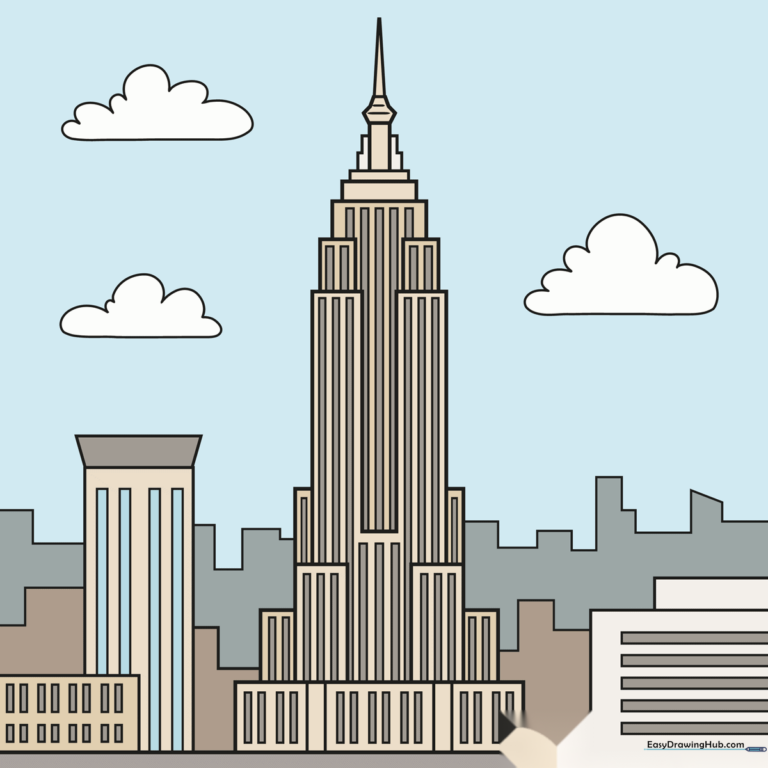
Capture the majesty of New York City’s most famous skyscraper with this beginner-friendly drawing tutorial. Designed for artists ages 6 and up, this activity uses basic geometric shapes to build architectural confidence. Grab a pencil, an eraser, and a ruler to start constructing your own skyline masterpiece.
🎯 Final Result
Step-by-Step Instructions
Step 1: Establishing the Foundation

Start by drawing a horizontal line at the bottom of your paper to serve as the ground. Above it, sketch a central rectangle for the base, then add four smaller vertical rectangles stacked on top. Teacher's Tip: Keep your lines light; these are just the structural guides for the building's tiers.
Step 2: Shaping the Mid-Section

Draw a large 'U' shape atop your rectangles to form the main body. Add small rectangles on the tips of the 'U' to represent the building's setbacks. Teacher's Tip: Focus on keeping the 'U' centered so your building doesn't look like it's leaning!
Step 3: Building the Upper Tiers

Add three horizontal rectangles that get progressively smaller as you move upward. Finish this section with a tall vertical rectangle on top. Teacher's Tip: Think of this like building with blocks—the smaller pieces always go on top to create that iconic skyscraper silhouette.
Step 4: The Iconic Spire
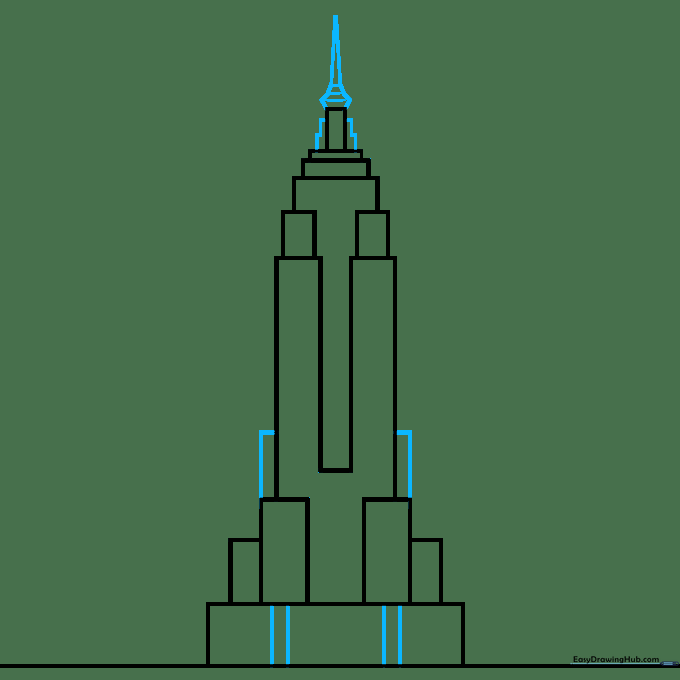
Add small rectangles at the base, then draw a hexagon, a trapezoid, and a thin triangle to form the spire. Fun Fact: The spire was originally designed as a mooring mast for airships! Teacher's Tip: Use short, quick strokes for the zigzag lines to give the spire a textured look.
Step 5: Adding Facade Texture

Draw narrow vertical rectangles along the base and lower levels to represent the building's windows and limestone panels. Teacher's Tip: Try to space them evenly to create a sense of rhythm and depth.
Step 6: Refining the Exterior

Continue adding long, narrow vertical rectangles across the front of the building. Teacher's Tip: If your hand gets tired, take a break! Drawing repetitive shapes is great practice for steadying your hand.
Step 7: Creating the Skyline

Draw overlapping rectangles and trapezoids around your main building to create a city skyline. Add small windows to these neighboring structures. Teacher's Tip: Vary the heights of these buildings to make the Empire State Building stand out as the tallest.
Step 8: Adding Background Depth

Fill in the background with irregular geometric shapes to suggest more buildings in the distance. Teacher's Tip: Keep these background shapes simpler and less detailed so they don't distract from your main subject.
Step 9: Final Touches

Complete your skyline by adding a few fluffy clouds in the sky. Teacher's Tip: Use soft, rounded lines for the clouds to contrast with the sharp, straight lines of the buildings.
Step 10: Bringing it to Life with Color

Color your drawing! Use light tan or gray tones for the limestone facade. Teacher's Tip: Use a darker shade for the windows to make them pop against the lighter building walls.
More Tutorials