How to Draw a Rainbow with a Pot of Gold: Easy 10-Step Guide
Perfect for ages 5 and up, this project turns a simple sheet of paper into a vibrant St. Patrick’s Day masterpiece. You’ll only need a pencil, an eraser, and your favorite markers or crayons. Follow along to build spatial awareness and practice smooth, curved line work.
🎯 Final Result

Step-by-Step Instructions
Sketching the Cauldron Base

Start by drawing the pot using two gentle, curved lines. At the bottom, add small, jagged 'V' shapes to represent the grassy hill. Teacher's Tip: Keep your hand loose to make the grass look natural and uneven, not like a straight fence.
Adding the Rim and Handles

Draw a narrow horizontal oval at the top of your pot. Add two 'C' shaped handles on the sides. Teacher's Tip: If the handles look uneven, just use your eraser to adjust the curve—it’s all part of the process!
Filling the Pot with Gold

Use connected 'U' shapes to create the pile of gold coins inside the pot. Teacher's Tip: Don't worry about making them perfect circles; a slightly irregular pile looks more realistic and fun.
Adding Coin Texture

Add small 'C' shapes across the coins to give them a rounded, metallic look. Teacher's Tip: This is a great way to practice shading and texture without needing complex tools.
Drawing the Cloud and Rainbow Arch

Draw a fluffy cloud using 'U' shapes, then extend two curved lines downward toward the pot. Teacher's Tip: Leave a small gap between the rainbow and the pot to make it look like it's floating in the sky.
Defining Rainbow Bands

Add parallel lines inside your rainbow arch. For a classic look, aim for six bands. Add small zigzags on the pot to show the gold's sparkle. Teacher's Tip: Use a ruler if you want perfectly straight lines, or go freehand for a softer, more artistic feel.
Adding Lucky Clovers

Draw a four-leaf clover at the base of the pot using heart-shaped leaves. Add a curved line for the hillside. Teacher's Tip: Hearts are just two 'C' shapes meeting at a point—a great way to practice basic shapes!
Expanding the Landscape

Add another hill behind the first one and tuck in a three-leaf shamrock. Teacher's Tip: Varying the size of your clovers adds depth to your drawing.
Final Details

Add a few 'spilled' coins near the pot using overlapping ovals. Teacher's Tip: This adds a sense of action and story to your drawing—where did the coins come from?
Bring It to Life with Color
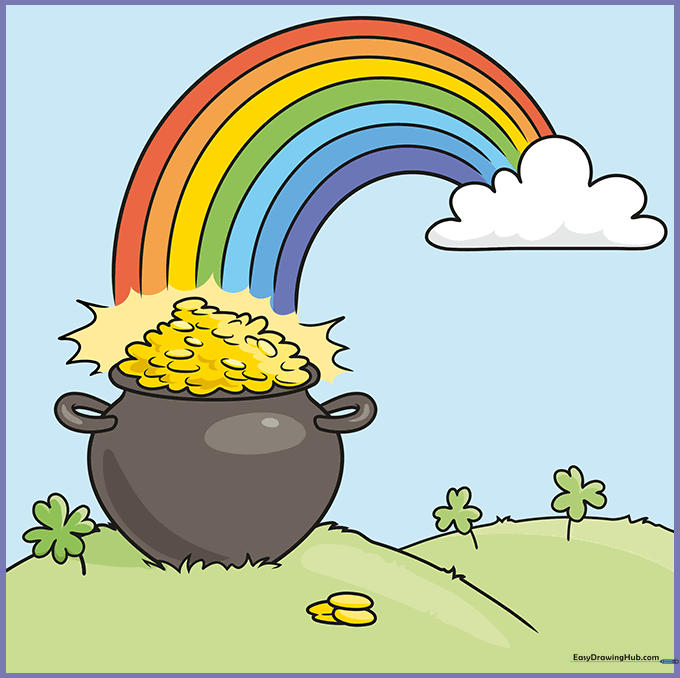
Time to color! Use black for the pot, bright yellow for the gold, and the full rainbow spectrum (Red, Orange, Yellow, Green, Blue, Indigo, Violet) for the arch. Teacher's Tip: Use light pressure with your crayons to blend colors smoothly.
More Tutorials


